
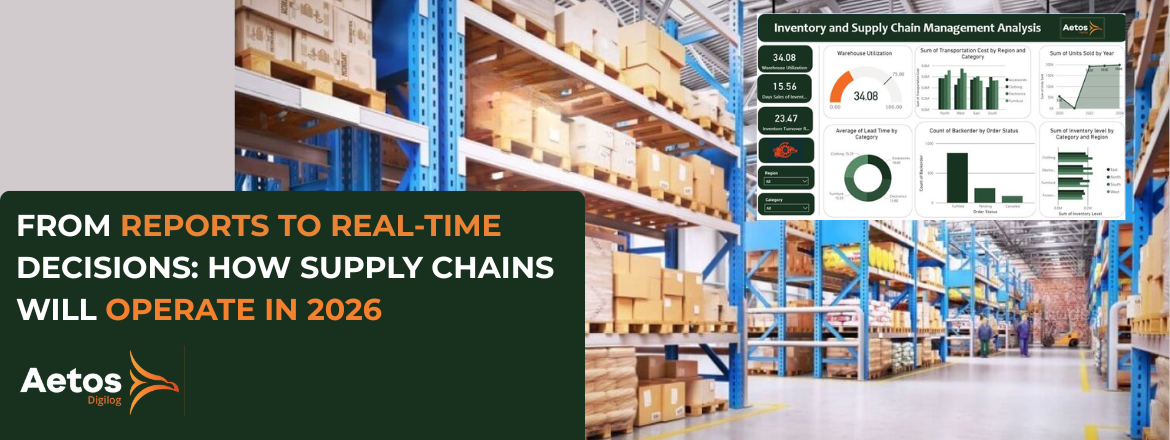
By 2026, the supply chain industry will have moved beyond the era of static dashboards and periodic batch reports. Traditional tracking methods, such as spreadsheets and legacy GPS tools, have failed to provide the necessary speed to respond to disruptions before they cause financial damage. The 2026 landscape is defined by adaptive intelligence, where fragmented processes have evolved into integrated, intelligent ecosystems that turn data into immediate, autonomous action.
1. The Evolution of Control Towers: From Visibility to Decision Engines
In 2026, supply chain Control Towers have undergone a radical transformation. Previously, they were used primarily for visibility, but they have now become true decision-making hubs.
• Prescriptive Orchestration: Modern control towers no longer just flag a delay; they actively orchestrate the response. Powered by AI, they can simulate “what-if” scenarios in real time evaluating the impact of tariff changes, geopolitical shocks, or capacity swings and automatically trigger mitigation actions such as rerouting freight or adjusting inventory levels.
• Item-Level Execution: These systems provide a unified view that allows logistics teams to see and act on orders and shipments down to individual items.
• Digital Twins: At the heart of these control towers is Digital Twin technology, which provides a dynamic virtual replica of the physical warehouse and logistics systems. This virtual environment is used to design, train, and test AI methods before they are deployed in physical operations, ensuring that real-time decisions are optimized for maximum efficiency.
2. The Critical Need for Real-Time Analytics
The shift toward real-time decision-making is driven by the fact that global supply chains are now too complex for human-led, manual oversight.
• Replacing EDI with APIs: By 2026, the industry has largely moved away from Electronic Data Interchange (EDI), a 1960s-era technology designed for periodic, one-way data transmission. Instead, API standardization has become the norm, enabling a two-way, real-time data exchange where shippers can query carrier systems and receive instant status updates for any event.
• Predictive ETAs: Real-time analytics have replaced “around noon” guesswork with Predictive ETAs. These systems ingest a “soup” of signals including live vehicle speed, weather-based changes, road closures, and even driver habits to forecast arrival times with minute-by-minute accuracy.
• Proactive Exception Management: Rather than reacting to a disruption after it happens, real-time platforms allow businesses to anticipate risks. If shipment velocity begins to decline in a critical lane, the system can trigger a procurement reallocation plan before downstream operations are ever affected.
3. Hyperautomation and “Agentic” AI
The transition to real-time decision-making is operationalized through hyperautomation and Agentic AI.
• Autonomous Decisions: Hyperautomation moves beyond simple robotic tasks. While standard RPA replicates repetitive human actions, hyperautomation integrates AI and machine learning to create fully autonomous systems capable of making complex decisions regarding demand forecasting and warehouse organization.
• Virtual Team Members: Agentic AI functions as a virtual team member, taking over repetitive, time-consuming tasks such as quoting, booking, and compliance checks. These agents are moving toward orchestrating entire workflows, where the AI predicts demand and books carriers in real time without human intervention.
• Warehouse Precision: In the warehouse, real-time analytics solve the task assignment and path planning (TAPP) problem. Each time a robot becomes available, the system analyzes the current state of the entire facility to assign the next most efficient task instantly.
However, the true differentiator in 2026 is not just the technology itself, but how it is used to build resilience and strategic advantage. Organizations that lean into this future replacing “gut instinct” with data-driven insights are achieving 20% fewer supply disruptions and significant reductions in excess inventory. This shift also redefines the workforce; as robots and AI handle repetitive “back-office” tasks like quoting and booking, human roles are being elevated to focus on complex scenario planning and collaborative system-thinking